webclerk
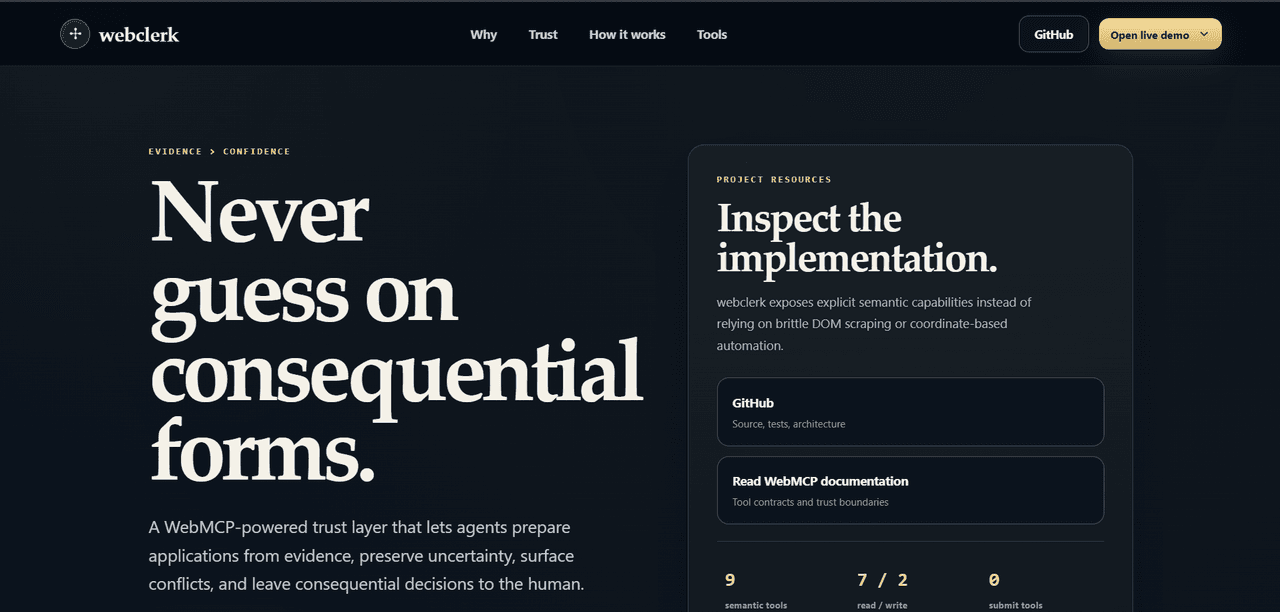
A trust-first WebMCP layer for consequential web forms where agents operate through semantic site tools, apply only evidence-backed edits, preserve conflicts and stale evidence, and leave declarations and final submission under human control.
WebMCP Challenge · live
Problem
Browser agents can fill consequential forms quickly, but ordinary automation makes it too easy to guess unsupported facts, hide uncertainty, or cross human-only decision boundaries.
Design principle
The agent can prepare a consequential form; the human retains the authority to commit.
- Semantic WebMCP tools
- 9
- Authorized write capabilities
- 2
- Agent submission capabilities
- 0
How it works
Inspect evidence
Read structured facts, field requirements, validity and unresolved conflicts.
Call semantic tools
The page registers WebMCP tools through document.modelContext; agents operate on domain concepts rather than DOM clicks.
Authorize mutations
The site's deterministic trust rules validate each proposed write before it reaches shared state.
Human review
Show reversible changes, blockers and preflight results; declarations and submission remain human-controlled.
Engineering decisions
- Enforce authority at the write boundary
- Unsupported values, stale evidence, conflicts and human-only actions return structured refusals before mutation. Model confidence is not authorization.
- Reuse the same state and rules
- Human UI and agent tools operate on the same browser-visible state; a workflow-configurable trust engine supports scholarship and motor insurance examples.
- Treat evidence as data
- Evidence-derived tool output carries untrustedContentHint. The domain engine, not document text or prompt-only instruction, determines allowed changes.
Verification and evidence
The fictional scholarship demo fills six fields from current evidence while preserving seeded income conflicts, stale evidence and the human declaration. The insurance workflow demonstrates the same nine-tool factory with a different field and evidence set. Repository tests document adversarial refusals, pre-mutation authorization and the absence of a submission tool.
Scope and limitations
The demo uses fictional, pre-extracted structured evidence. Arbitrary OCR and document extraction are outside the prototype, and the scholarship workflow is not affiliated with a public authority. This is a demonstration of a reusable trust boundary, not a claim of production compliance or universal form coverage.