O.A.S.I.S.
Oncology Assessment & Screening Information System, an explainable clinician-facing prototype for screening and referral prioritisation across oral, breast, and cervical cancer pathways.
SIH 2026 university internal nomination · prototype
Problem
Cancer-screening workflows need to prioritize referral urgency while keeping red flags, eligibility rules, model outputs, and clinical uncertainty legible to the people making decisions.
Design principle
Referral prioritisation must preserve clinical uncertainty rather than turn an experimental score into a diagnosis.
- Screening pathways
- 3
- Assessment workflow steps
- 6
- Prospective or external clinical validations documented
- 0
How it works
Collect assessment information
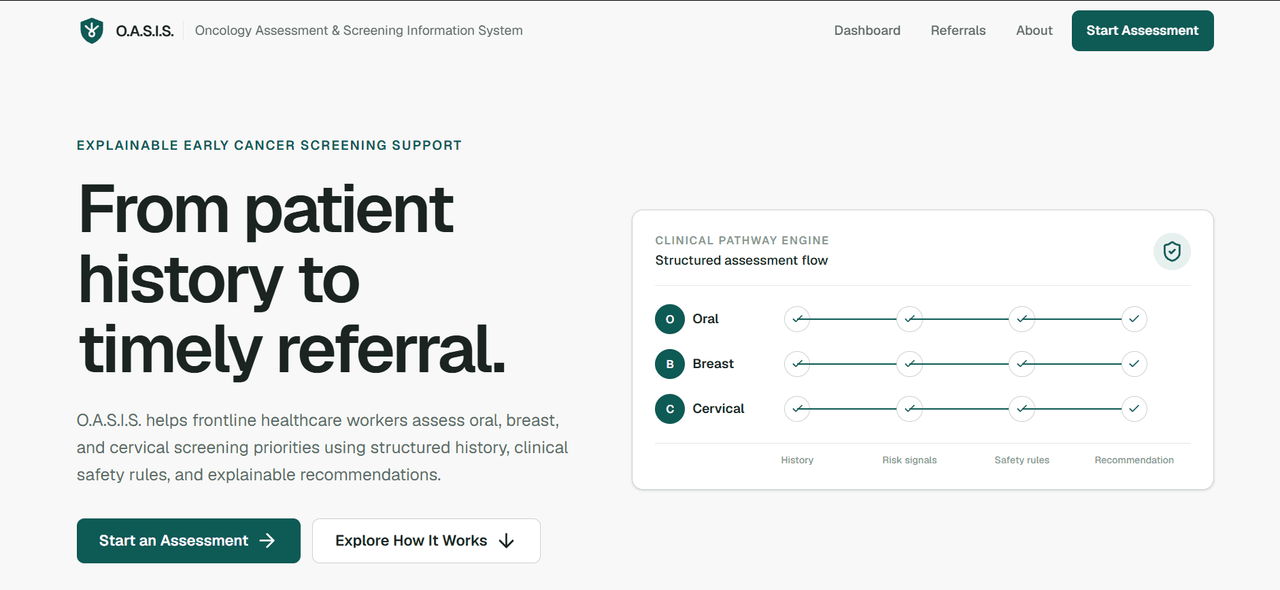
The prototype guides oral, breast and cervical screening information through a six-step interface.
Apply clinical safety rules
Red flags and abnormal examination findings are considered before optional statistical support.
Calculate referral priority
Combine rule-backed eligibility and optional experimental support into an ordinal Screening Priority Index, separate from cancer probability.
Present reasons and history
Persist assessment summaries and show pathway priorities, rationale and referral print views.
Engineering decisions
- Symptoms override low model output
- The decision model does not permit a low experimental prediction to negate symptoms or abnormal findings.
- Separate urgency from diagnosis
- A priority index expresses referral urgency; it is neither a cancer probability nor an exclusion test.
- Keep evidence review explicit
- Thresholds and programme rules are configuration-backed and require clinician and local-programme review before any deployment.
Verification and evidence
The repository documents the Next.js and FastAPI workflow, persisted assessment summaries, synthetic demo scenarios, evidence matrix and model card. The case study describes prototype functionality and safety intent, not clinical efficacy.
Scope and limitations
This research prototype has no prospective or external clinical validation. It cannot diagnose or exclude cancer or replace professional judgement, clinical examination or local protocols. Experimental model representativeness, missingness and bias remain concerns.